Everyone Writes the Histories

History is such a fragile, mutable, conditional thing: History is ineffable.

It’s all very well to say, no, it is what happened, it’s indelible, it is actual… So it is, an event, an action, plays out its options and leads to its conclusion. But that isn’t history. History is the story of what happened, and that is prey to any agenda, any perceptual filtering, angle of witness, sense of importance and imperative.

This is why we cannot truly know what happened, and the closest we can get to the actuality of the occasion is by getting as many versions of it as we can, by being aware of the sources’ own biases, by taking into account perspectives and pacing of the moment and of the observers of it.

Each and every observer, standing in their own shoes, being within their own heads, possesses the truth of the event from their own perspective.

Every analyst of those observations looks through the filters of their own purpose in looking for the facts of the event.

Professional historians dig deep into the records to find as many angles and versions as they can. They do consider the sources, and work with their own knowledge of how people are, generally and specifically, and how things relate to one another. They look at all the material with some sense of logic and absurdity–both major factors in human actions–and finally come to conclusions with the preamble of, “This is what I think happened.”

So, when history is offered up to students in school, or to the public of a nation, it’s vital to look at why that version has been chosen.

It’s often said that “The winners write the histories.” Glib, but not so. The winners write the school books and the ‘official’ histories. But everyone writes histories, especially the losers who want their perspective known, and the official versions challenged.

Tolkien Tribute: “Speak, Friend and Enter”

Several years ago, I spent a lot of time on a Tolkien-based website that ran writing competitions. This was a dialogue Challenge with these parameters:
Characters: A dwarf and an elf
Setting:  The West-gate of Moria.
Theme:  Speak, Friend, and Enter
I set myself the added challenge to write the entire piece as dialogue, showing the setting and actions within the spoken words.


Greetings, friend Elf!   What’s that th’art doing, kneeling by the doorstep of Khazad-dum?  Elf?  I speak to thee– Wilt not look up and greet me?

–I do rise now, Friend Dwarf, and I greet thee, too.  I was conversing, as thee came out through the great doors.

–Yes, I did perceive that.  But not to me.

–No, not to thee.

–That’s as well, Elf, because I do not understand thy language. And yet, there’s no one here but thee and me.

–Is there not, Dwarf?

–I look there…  I look here…  See, I even look up…!   I see no one else.

–Ah.

Ah? What, ah? Don’t thee look down thy delicate Elven nose at me, friend Elf, and say Ah, as if thee knows all of my kind, and all of my nature!  I beg thy pardon if I interrupt thy converse, I do so but in ignorance.  And if thou would but introduce me to whom thee speaks, mayhap the chat can encompass us all!

–I bow to thee, friend Dwarf, and humbly I beg thy pardon.  I did not intend rudeness.  Let me introduce thee to these two holly trees, just now planted by the doors: I water them from the gate stream, just so…   and nurture them with words.

–These two wee twigs?  They are to whom thee speaks?

–Indeed, they are!  Twigs they are in seeming, but they are trees, too, great and lovely in the fullness of Time, and in the heart of them even now. It is indeed to them that I speak.

Why?

–Ah, do forgive my mirth, friend Dwarf, but the tone of amaze in thy voice and the bafflement upon thy brow remind me that though we are friends we are not kin, and not all things are understood between us! 
I speak to them because they are young : and newly planted are their feet in this soil.  Because they are uncertain and shy.

–Are they?

–Aye, my friend, they are– and I would not have them shrivel, feeling that, being so  slight and meek,  they do not belong in this place by the great  Gateway to the wondrous Realm of Khazad-dum! My words to them awaken their strength and courage, and remind them who they are.  For they are already what they will be.

–And they–these wee baby trees– they understand thy words, do they?

–I speak to them in their own language, that they shall…  Every Elf knows the tongue of every living thing. 
Why now thy creased brow, friend Dwarf?

–It is a mystery to me, a Dwarf, my friend, this language of twigs and trees.  And now I understand thee, I am sorry that I cannot give to these young lordlings the gift of nurturance, too, for I also wish to see them, one day seasons hence, standing brave beside the Door.  It grieves me I cannot bless them as thee does, though they grace the doorstep of my home.  Therefore, I sigh, and thee sees the furrowing of…  Wait a moment, though…  Ha!  Make a little room there…

–Of course… but to what purpose does thee kneel?  Dwarf? Dost thou hear me? Dwarf…? Why does thee bow thy head beside thine own door?  Dwarf…? 
Very well then, I shall wait…  
Elbereth’s stars are wondrous bright this night, and light the new letters Narvi made…  These letters and these words, together, shall speak the welcome of friend to friend down the ages of this Middle-earth, and give honor to the love and respect of the Free Folk, each for the other..  Fades the daylight from the sky, and the Moon, she rises great and brilliant among them and Narvi’s work blazes…! 

AhhOh!  Stiff knees, Elf… May thee never know them!  I see the Sun has gone through the Gates in the West,  and the Moon, she climbs the sky…    I did not realize…  I did not mean to keep thee waiting…  By Durin’s beard, look at how the words shine out above our heads!  Oh, but, again, thy pardon, Friend Elf… 

–No matter, Dwarf, there is plenty of time in the world!  And the lights of the Doorway are good to see…  Did thee speak to the trees?

–Nay, that I cannot do in any tongue they could hear.  I leave that to thee and thy kin..  I addressed myself to another.

–Friend Dwarf, now it is I who see no other. 

–Ah!  Thy quick and lively kind see and speak to the green and growing things, and those that scurry about all across the land, but it takes a Dwarf to converse with stone!

–With stone?  Stone? This is a marvel!  I had not thought stone had will to hear, or speak!

–Yet, my friend, it does! One must have not the quick ears of the Elf, , but the deep ears of Dwarves, to hear it.  And the language of stone is one that every Dwarf knows!

–And what words had thee for the stone, friend Dwarf? for I am mightily curious to know!

–Gladly, then, I shall ease your curiosity!  I asked the wild rock of the mountain, and the tamed stone of the door and the step, to welcome and make way for the roots and branches of the wee trees; to share the nurture that they are made of, with these younglings, to shade and cool them when the sun beats hard, and shelter them from pounding weather.  I asked  the stone to give of the warmth it soaks up from the summer sun, when winter freezes the land, and to give the blessings of the mountain’s own roots to encourage and instruct these trees, that their own roots will hold fast and be strong and go deep.
This is what I spoke to the stone.

–Ah!

Ah, indeed!  Now, we have both spoken, friend– Let us enter, and sup together in good-will, and raise a cup that our friendship shall last as long as the stones and the trees!

OCT 2004

“Is a Puzzlement!”

…To quote the King of Siam.

   The Universe is, to me, a great, multi-dimensional jigsaw puzzle, with no outside edges.  Each of us has bags of pieces collected over our lifetimes from our own experience, and from others whose experience we trust.

   What I pour out here is my bag of pieces: If you see some you like, that look like they might fit into your puzzle as you’ve got it put together so far, take them and play with them and see what you get.  Ignore the ones that are clearly not part of the part of the puzzle you’re working on.  And if you don’t mind, I will paw through the pieces you spill out here, and get all giddy when I find a new one that fits mine! 

     I love that feeling of exhileration that comes when another piece clicks into place, and its seams disappear, and the picture is that bit more revealed…!

And that is what this blog is about.

I’ve been asking the Universe to explain itself to me since I was about 11 years old. I asked then, how to reconcile God with Science. Being the child of a scientist and a mystic, such a question came naturally to me. Now and then, I seem to tune in on an answer: The puzzle pieces come together.

All that I write here represents not Truth, but what I believe to be true. I have my reasons, and I like to believe, my reason. I hope it will lead to adult discussion. Not prosletyzing… If that’s what you want to do, you will have to create your own place for it.

When We Abandoned Eden…

I have written about the ‘abandonment of Eden’ as the time in which our developing, evolving human intellect outpaced and replaced animal instinct as our primary means of interacting with the world around us, particularly the physical world. I have suggested that choosing intellect and self-reliance was something to be celebrated, not to be ashamed of. I’ve suggested before that we were not punished by any Divine by being thrown out of Eden, but chose to leave, that we could not have been prevented from leaving. But then, perhaps our striding willingly, willfully out of Eden also cost us something.

In that time, while we remained animals in form, our minds took us into a place beyond simple acquiesence to whatever Nature/God provided for our well-being: We took the responsibility into our own hands and minds, to provide for ourselves. We entered a kind of species-adolescence, no longer content to be subject to the demands and methods of Nature or the whims of a personal God.

In that time where intellect took over management of our affairs, we adopted some mental/emotional methods of our own to attempt to do what Nature did not: to make life more comfortable, more fair for the individual instead of only balanced on the scale of species. We came up with the notions of morality and ethics, and as we gathered in every greater concentrations we codified such concepts into law: ‘Fairness’ became ‘justice’ became ‘law.’

As humankind complicated simple living into ever more intricate constructs and rules, we had to evolve record-keeping, first in oral traditions, then finally in written forms. We told stories, and then we wrote them down, creating cultural memories with the force of codification. Specialization in certain areas were the beginnings not just of the legal professsion, but also religion: The attempt to codify spirituality. And politics, through written documents codified the consolidation of power of some people over other people.

Underlying all this was what we might consider the conscience of human culture: Morality. Ethics are the rules by which we maintain morality: the ‘how’ of the ‘why.’ Morality and ethics enabled human beings to live together, to establish traditions and habits of behavior and reasoning, to measure ourselves against some kind of greater-than-the-individual and fairly vague standard of goodness/badness, or Good/Evil.

Morality has also evolved as the human species has continued its path towards maturity. In these times, one of the great moral dilemmas is whether it is moral at all to consume the flesh of other animals, and if that is moral, then is it moral to raise animals solely so that we can consume their flesh and use their bodies for our own comfort? And if killing for any reason, but especially for personal aggrandizement, entertainment, and whimsy, is not moral, then is killing evil?

This is the root of the cognitive dissonance I experience when watching those documentaries about the natural world, “red in tooth and claw.” I watch the gazelle, the image of beauty and grace with big sweet eyes, run down by the noble great cat with her own grace and beauty, who has kittens to be fed. I want the gazelle to live, but at the same time, I want the kittens to live. I want to see all the grace, all the beauty triumph. But Nature doesn’t work that way: there are grass-eaters and meat-eaters, and there are scavengers and opportunists, and those who will eat anything.

Is eating the root of all evil?

But there it is: Evil is another of those human moral concepts, just as is Good. They are two ends of a spectrum that exists only in the human intellect, as far as we know, and these are definers of our comfort/discomfort zones. They are not as absolute, ever, as we would like them to be.

So, I watch the cat and the gazelle, and the spider and the moth, the big fish and the little fish. And I wonder, how is it this is not about Good and Evil? How is it not about moral choices and imperatives? How do I see this without the persistant and pervasive force of my humanity?

It is nearly impossible to transcend the limits of what one is. But intellect and mind are so much greater than the physical package they come in. Imagination takes us through boundaries, transcends limits as far as we will allow ourselves to go. So, to some very limited degree, I can see past the human perspective and see possibilities…

We know that animals use senses differently from how we humans do. Starlings can flock in murmurations; salmon can return to the very stream where they first hatched; insects see into ultra-violet wavelengths; elephants communicate in deep sounds below human ability to hear… Many species migrate by paths invisible to human senses, following them for thousands of miles at the right times and seasons. Magnetism has been postulated as a mechanism for such migrations. But maybe there is more: species-memory or in species of more complex cognition, actual cultural tradition?

Can you imagine… that natural, wild animals who still live in Eden, or Jurassic Park, if you prefer that metaphor, are ineffably, literally, awarely linked in a network of all life on the planet? The network of planetary life-energy isn’t hard to posit, part of the same mechanism as instinct that guides animals through their lives.

I am imagining that such connectedness to the natural Whole gives wild animals a very different sense of what death is and means, and while every creature strives to live, the end of life is an acceptable part of living. Therefore, though the body fights to live as long as it can, the Nature-linked consciousness is not traumatized by dying or death.

I imagine, further, that the more intellect a creature commands, the harder it is to maintain awareness of that link, but as long as there is instinct at all, awareness of the link is possible. Higher-consciousness animals–the Great Apes, elephants, some birds, for instance–and those who live domesticated to humans, such as dogs, cats, horses and others, grieve the death of a bonded other. Some humans transcend the antipathy for death that is rooted in our animal/body self.

I believe that such a link explains many of the animal behaviors and capabilities that have mystified human intellect since we turned away from magic and divine whim, and towards scientific and rational explanations for what we see in the world.

While I can’t ‘prove’ it scientifically, it satisfies what I consider my moral obligation to seek truths that fit the patterns and mysteries I perceive.

Finally, this is what we lost by our abandonment of our animal nature: When we abandoned Eden, when we began the subjugation of Jurassic Park, we diminished our personal awareness of our actual connectedness to Providence that was ours in Eden.

In that sense of superiority that came with taking over management of our own affairs, we attempt to fill the empty space of that loss with anthropomorphic notions of how other animals think, feel, and perceive the world: We try to make them more like us because we have misplaced what it is to be more like them.

“What is a ‘weekend’?”

My son said yesterday evening that he’d thought it was Monday all day. I told him to wait a bit, and it would be. But as it’s a federal holiday, in fact this week ‘Monday’ will not really be happening until Tuesday. 

So many things we take for granted, we forget they are not, in fact, absolute and immutable. The week, for instance. Seven day chunks define our sense of a full course of days before the pattern of work and relaxation repeats. In current times, in Western society, it begins and ends each cycle with a day understood to be set aside for spiritual observance, usually Saturday or Sunday. 

The ancient  Etruscans and Romans lived and worked with eight day weeks. The Egyptians defined the repeating pattern of work and life in ten day weeks. That had a brief resurgance in Revolutionary France as they attempted to detach life from the religiously defined calender, but it wasn’t a success. 

I’m not suggesting that our cultural habit of generations be changed, just that it’s interesting to think about it, to imagine if we lived weeks that were not seven days. For one thing, we’d have to come up with names for the additional days. Any suggestions…?

Or what if we shortened the repeating pattern to five or six days? Which names would we drop? Or would we find all new names, just to redefine the week, to escape the traditions we are so used to?

Downton Abbey – “What Is A Weekend?” – YouTube

Travelblogue: The American West: Carlsbad Caverns

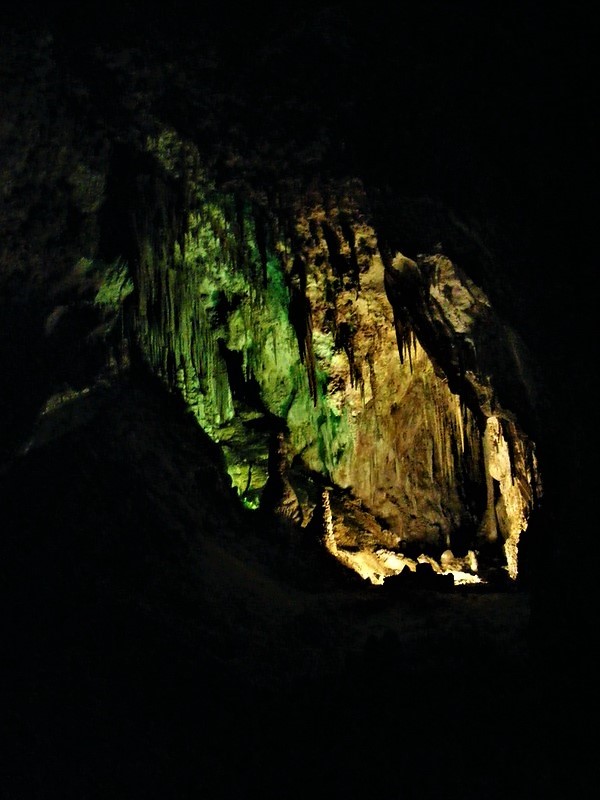
The experience of Carlsbad Caverns in New Mexico begins with a leisurely stroll down a paved path that descends over a mile from daylight into the perpetual night of one of most spectacular publicly accessible caverns in the world.

I’ve been there three times now, the first as a child of 10, the second when I took my son near the same age, and the third on my own as an adult, with a camera. Over those ~50 years of visits, nothing has changed: not the long entry, the astonishing geologic features, not even the Lunch Room at the lowest chamber of public use, and its boxed lunches! Also, that long descent every time resulted in shin splints, so some visitors might be glad to know of the elevators from the above-ground visitors center down to the Lunch Room from where it’s possible to explore the more level lower chambers and sights.

https://flic.kr/s/aHskzrVPrB

One of the most popular features of a visit to Carlsbad Caverns is the evening bat-flight, as hundreds of thousands of bats emerge through the cave’s natural entrance for their night’s foraging.

(Wikipedia has a very informative article about Carlsbad Caverns National Park of which the Caverns themselves are only a part.)

https://en.wikipedia.org/wiki/Carlsbad_Caverns_National_Park

Travelblogue: The American West: Pike’s Peak Region

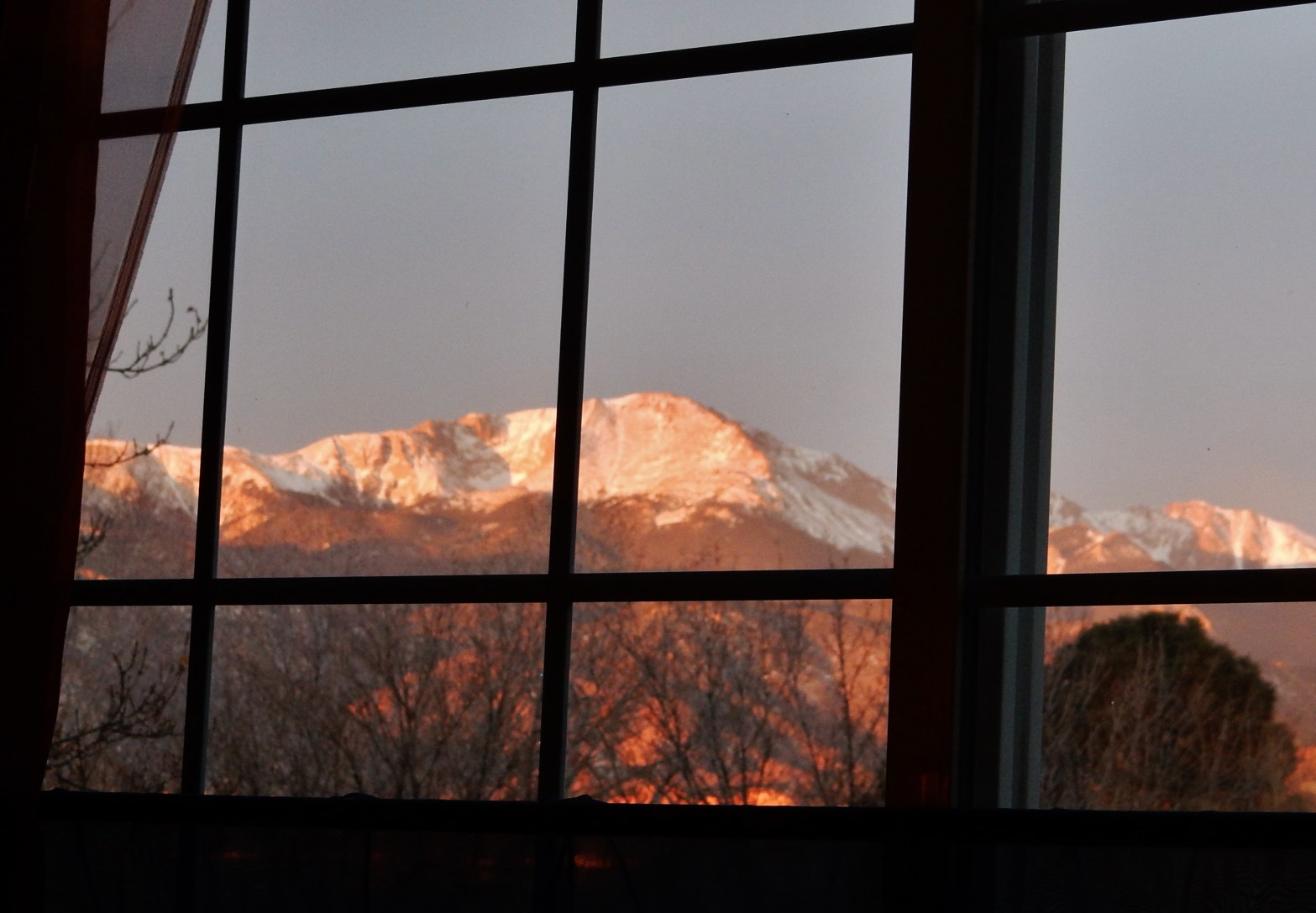
I have lived in Colorado for some years now with a view of Pike’s Peak outside my window. Many of these photos are of the mountain itself from various places in Colorado Springs: Sunrises and sunsets, clouds and storms, moon sets… The Mountain is always there, and always different!

I’ve driven up into and around the mountain many times. There are roads both paved, and not. There are wild animals and livestock along the way. There are signs revealing of human activity and character. Cripple Creek has become a casino townand has a small herd of free-roaming donkeys. Victor remains modest and charming.

Images in this collection are from the Pike’s Peak Highway up to the summit of Pike’s Peak, and the back roads to Cripple Creek and Victor. From Victor, another road runs through the Phantom Canyon. Autumn is a time of particular beauty, so many of them are full of color.

https://flic.kr/s/aHsjBuxrYb

Travelblogue: The American West: Bryce Canyon National Park

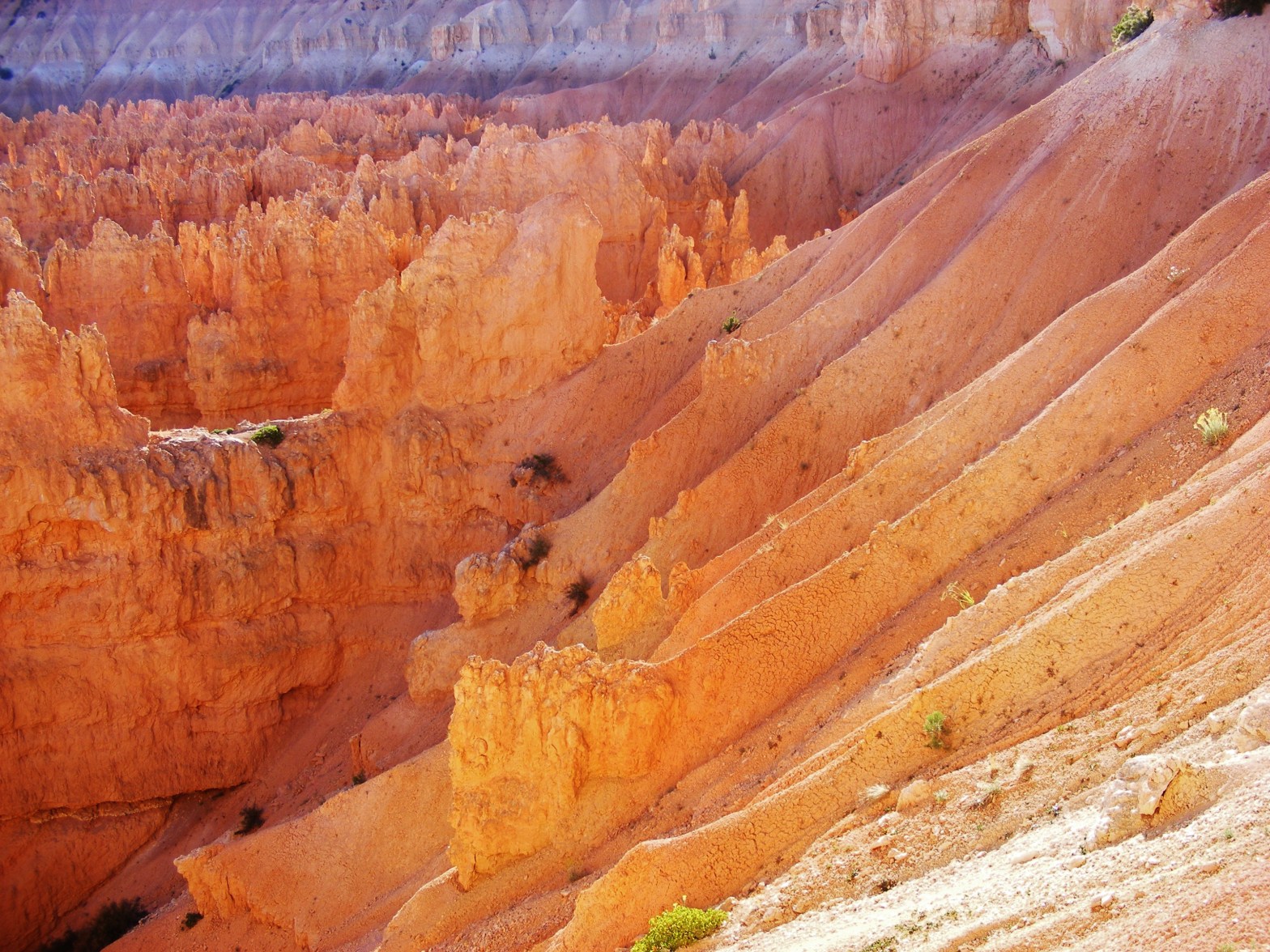
The first time I visited this spectacular park in southern Utah, I had some wonkiness going on with my knees, and no matter how they tempted and beckoned, I could only stand and take photos from the rim. The second time, a few years later, I was finally able to follow the call of the trails and go down among the the hoodoos.

https://flic.kr/s/aHsjv5SDsF

To the east of Bryce is the much less-known, less-visited Kodachrome Basin State Park. Between my knees and time constraints, I only hiked one of its trails, the Shakespeare Arch trail, and mostly took pictures of the vegetation there. I still promise myself I’ll go back one day and actually get more of the geologic features of more of the Park.

https://flic.kr/s/aHsk1mgJeN

The name of the park, by the way, is in recognition of the advent of kodachrome film which was introduced in 1948.

The Shakespeare Arch, also, is not named for the playwrite, but for its original Euro American discoverer. I have no information about earlier native discoverers and names they gave this area.

Travelblogue: American West: Yellowstone National Park

American’s, and in fact, the world’s first National Park is in the northwestern corner of the state of Wyoming, with some overlap into Montana and Idaho. It is one of the most popular and dramatic of the National Parks, featuring abundant western wildlife, geologic and thermal regions, and some spectacular scenery.

You won’t see Old Faithful among these images, or Morning Glory Pool, or Yellowstone Lake. It’s a big park, and my travels through it didn’t cover all the roads. Also, those very popular locales are often very crowded.

https://flic.kr/s/aHsjUrtqGD
I was first here when I was 10, with my parents, and those were the days of bear-jams on the roads, and bears in the campgrounds. My more recent travels, I’ve seen no bears: It is the bison that dominate the landscape, and create the traffic jams.

https://flic.kr/s/aHsjUwmpd8
Every time I’ve visited this park, I’ve spent some time walking among the thermal areas, especially fascinated by the bubbling mudpits.

https://flic.kr/s/aHsjoyoUqw
The Yellowstone River is very shallow in some areas, and lovely shades of blue and green. These images were taken above the renowned Lower Falls.

https://flic.kr/s/aHsjoxPco7
On one visit I made sure to vist the view points above the Lower Falls at sunrise, to catch the golden light on the canyon walls. A little later, I walked down the trail into the canyon near where the falls descend.